Anti-wrinkle injections for frown lines — the vertical lines between the eyebrows — are among the most commonly performed cosmetic procedures worldwide. Despite this, many patients are surprised to learn that the technique used to treat this area is often remarkably uniform.
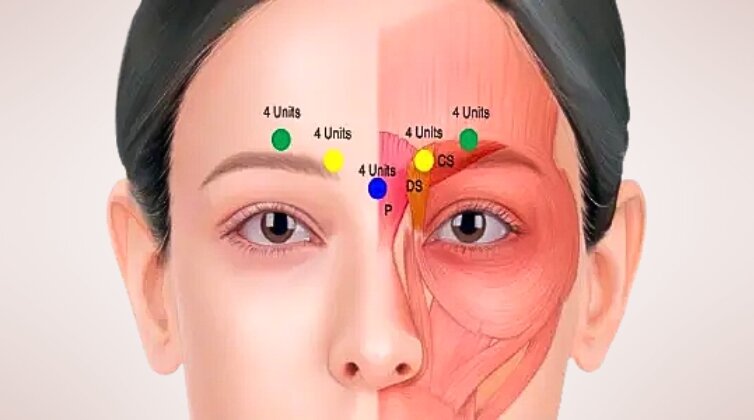
In many clinics, frown lines are treated using a five-point injection pattern — the same diagram, repeated across many different faces.
So where did this approach come from?
And is it really designed around individual facial anatomy?
The Origin of the 5-Point Frown Line Technique
The traditional five-point injection pattern did not arise from facial anatomy textbooks or personalised treatment philosophy. Instead, it originates from the original clinical trials used to obtain regulatory approval for botulinum toxin type A for cosmetic use.
In 2002, Botox Cosmetic was approved by the U.S. Food and Drug Administration (FDA) for the temporary improvement of moderate to severe glabellar lines (frown lines). To conduct these trials, researchers needed:
- A standardised dose
- A repeatable injection pattern
- A method that could be applied consistently across large patient groups
As a result, the trial protocol used:
- A total dose of 20 units
- Delivered across five fixed injection points
- Targeting the corrugator supercilii and procerus muscles
This approach allowed outcomes to be measured reliably. However, it was designed for research consistency, not individual facial variation.
Over time, this trial diagram became widely taught and adopted as the default method in clinical practice.